
Marcel Breuer
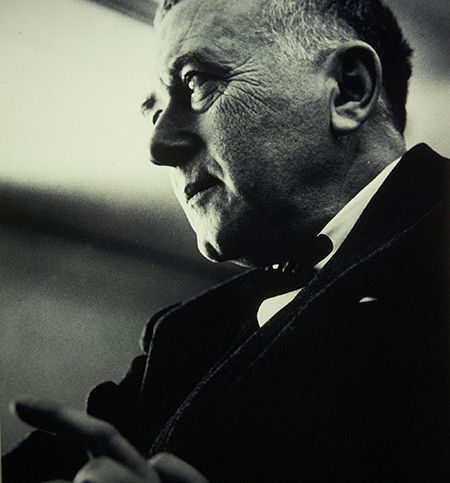
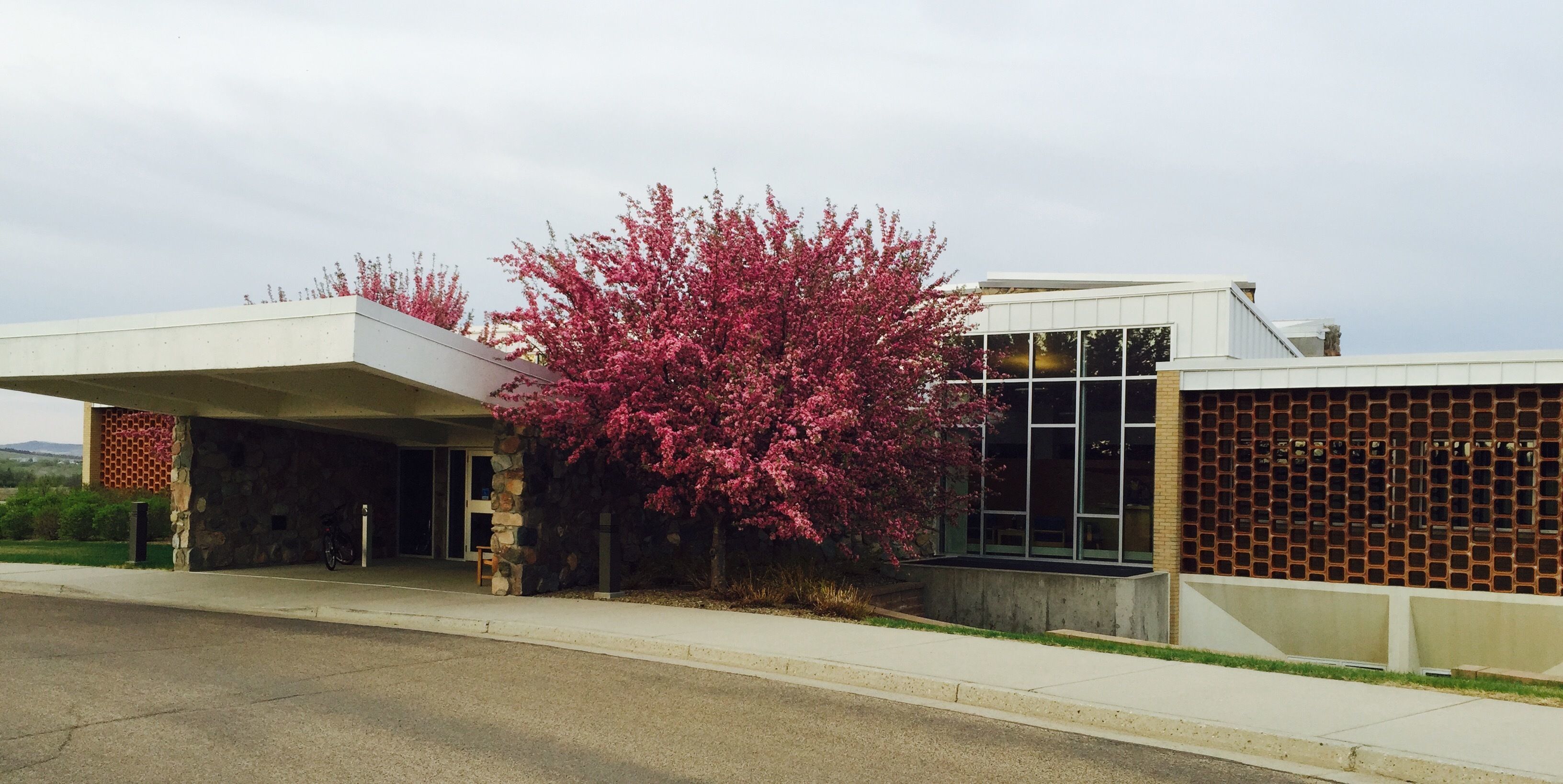
In the 1950s, just a few years after gaining permission from Rome to form an independent community, now known as Annunciation Monastery, the Sisters asked world-renowned architect Marcel Breuer if he would design their first home. To their delight, Breuer accepted and designed what he called, "A jewel on the prairie." This expansive building made of stone and exquisite concrete shapes is well-known for its architectural beauty.
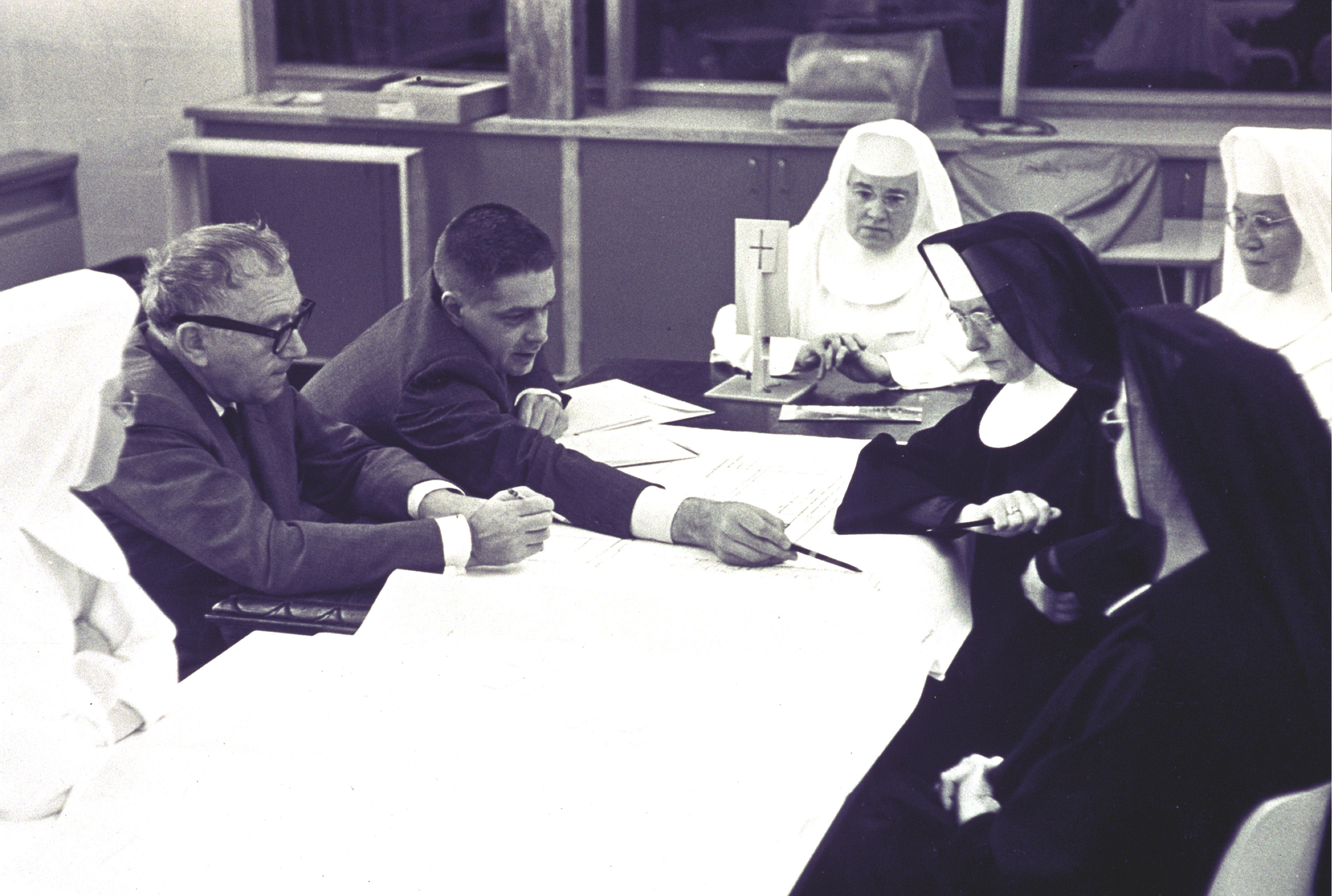
The sisters enjoyed the time they had meeting with architects Marcel Breuer and Hamilton Smith.
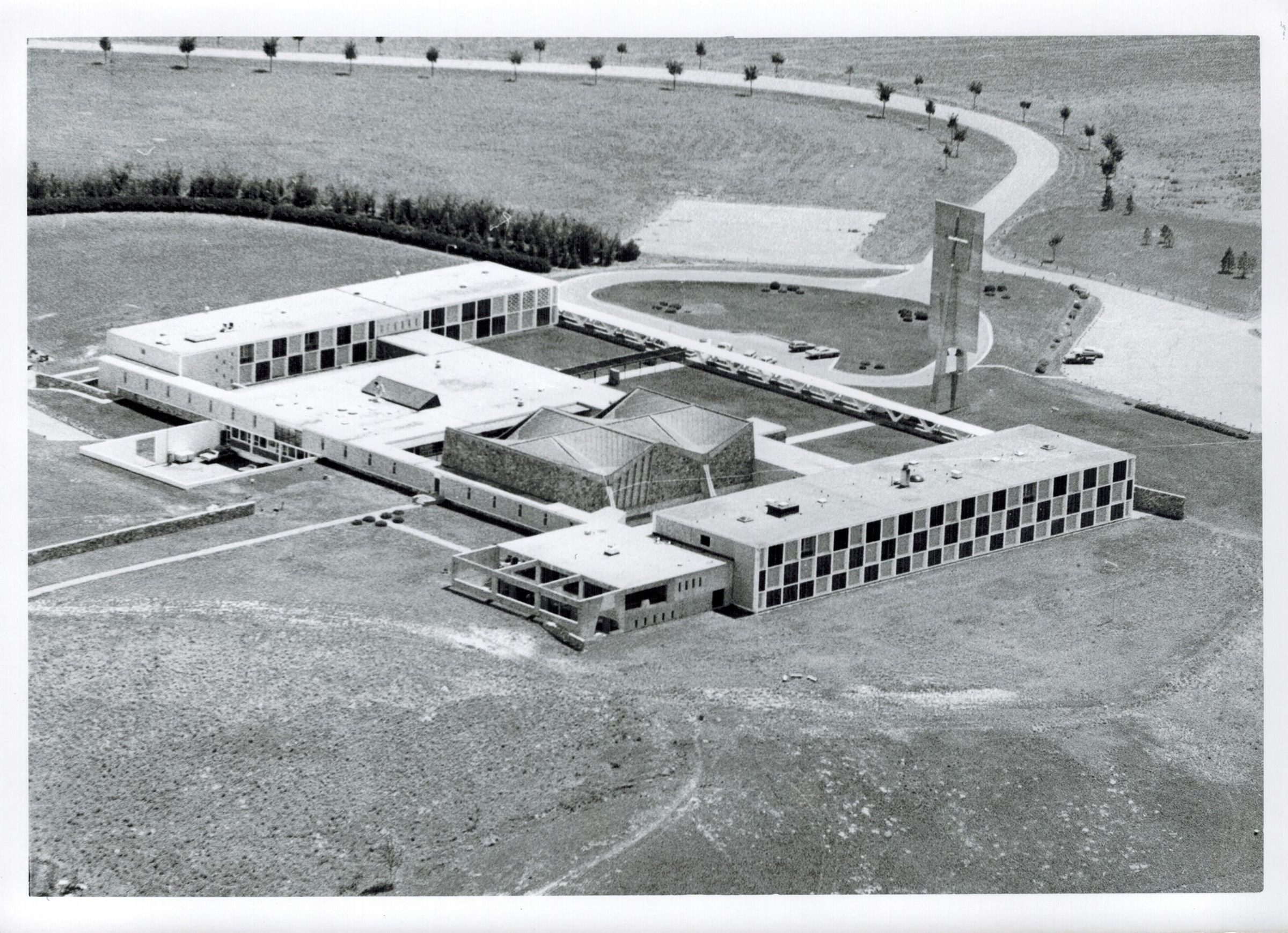
Below is a link to a walking tour of Breuer architecture on the University of Mary campus. The 100-ft. bell banner is the landmark and symbol of the founders, the Benedictine Sisters of Annunciation Monastery.
https://issuu.com/umary/docs/breuer_walking_tour_
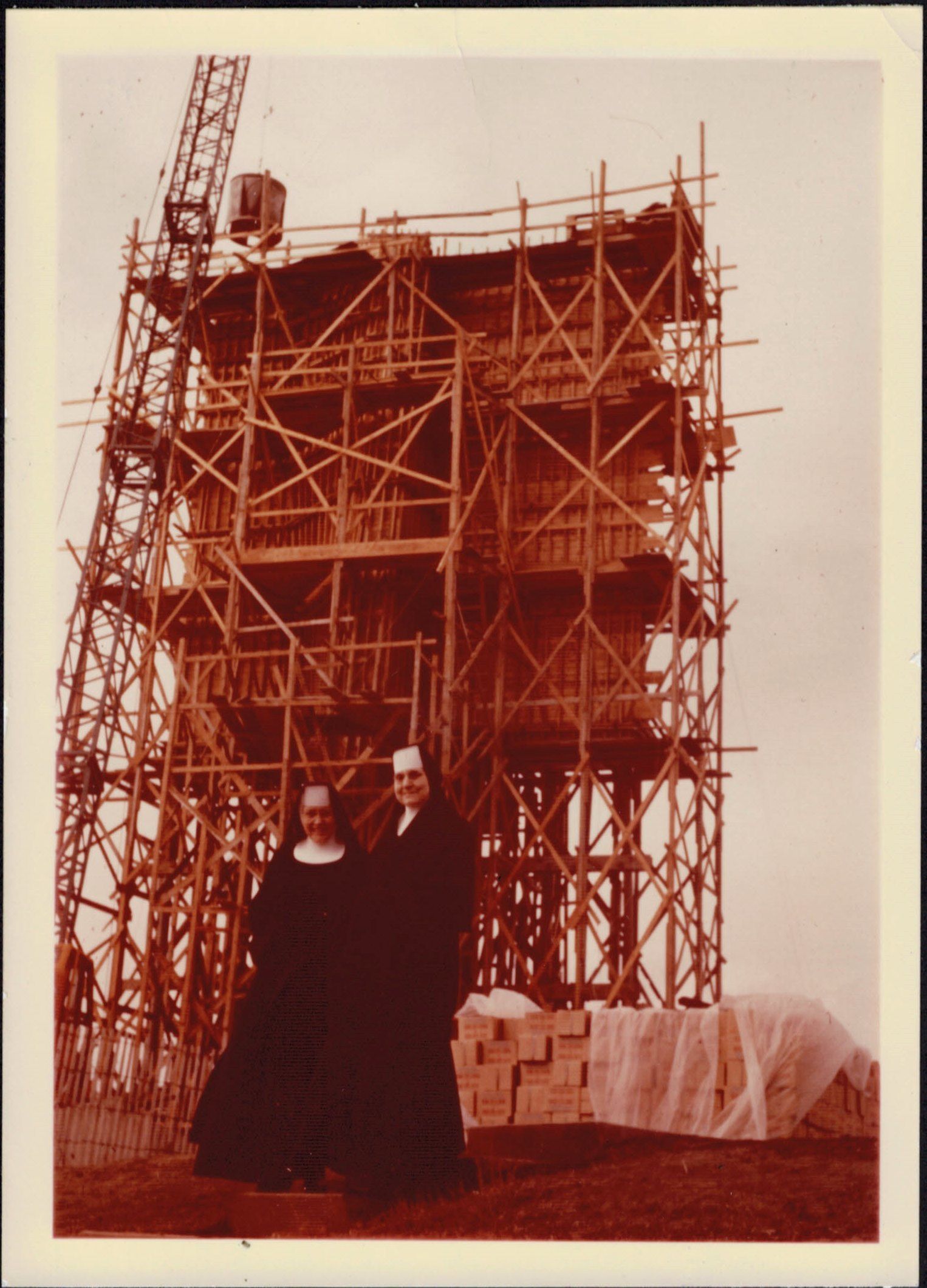
The 100 foot bell banner, our community's trademark, under construction in 1962.
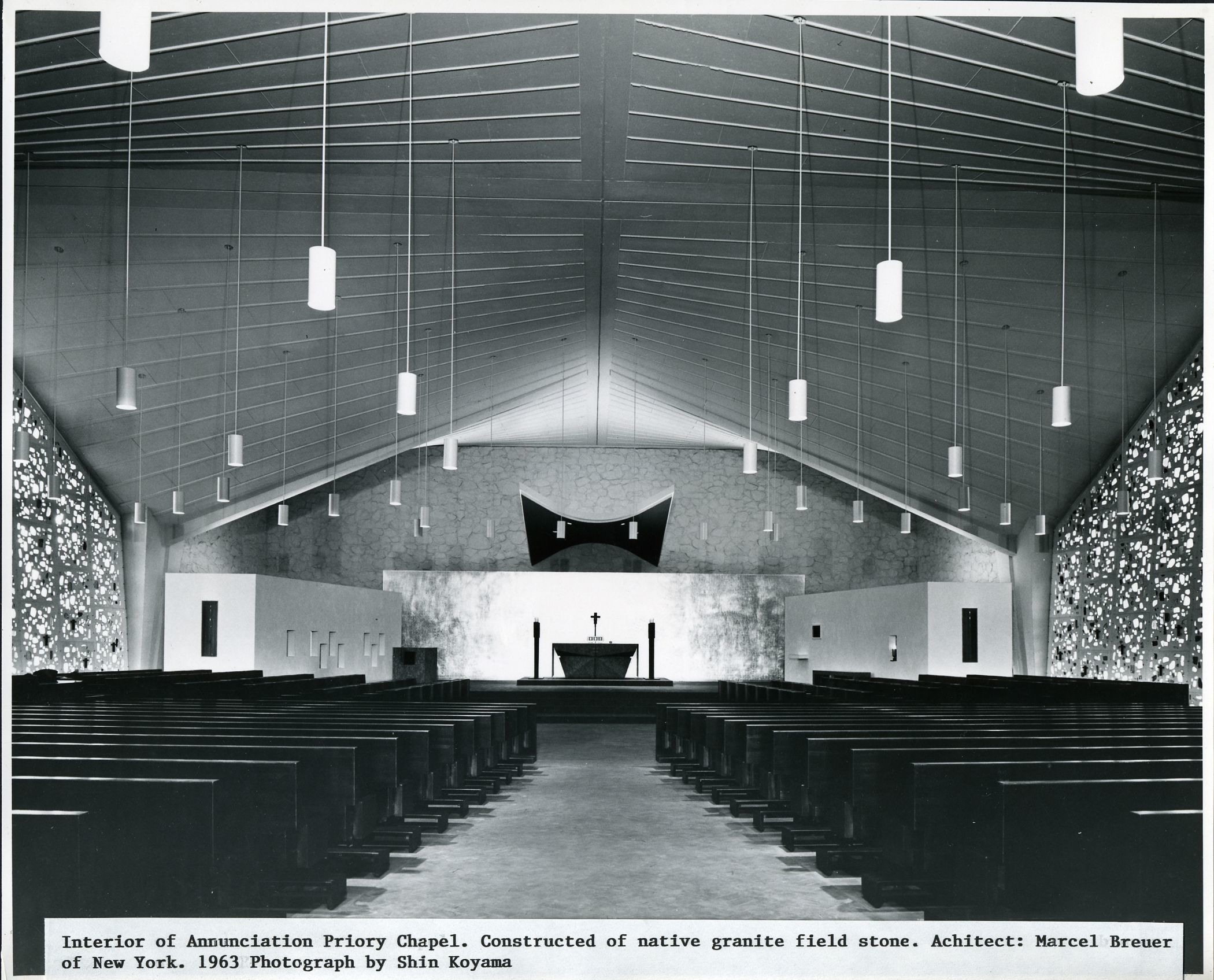
Sisters, students from Priory High and Mary College gather with Bishop Hacker and diocesan clergy in the newly constructed Our Lady of the Annunciation Chapel during its dedication May 13, 1963.
Characteristic of Breuer's work is the play of light and shadow. When we built our new monastery in 1999, we incorporated Breuer's design, because it has influenced us as a community.
Self-Guided Tour of Breuer Architecture (downloadable)
Self-Guided Tour of Breuer Architecture
The Architecture of Marcel Breuer - by Sister Edith Selzler
Jesus said, "A city on a hill cannot be hidden." It has been a Benedictine tradition to build on mountaintops and high places, and to become a beacon of light for the people of God in the region. Also part of the tradition has been the building of monastic structures beautiful and worthy to house the light that is radiated in mission and leadership. This hilltop monastery and University campus in Bismarck, North Dakota, is true to that tradition in the care that the Sisters gave to locating a lofty and beautiful site and choosing, with daring leadership, a great architect who could design buildings that would become art treasures for the nation and world. We celebrate, in this place, the shining jewel he created, from which we reflect beams of God's light to the region, the nation and to all parts of the world to which the Sisters, University of Mary graduates and faculty go to serve.
Let us think about these buildings as visible parables of Benedictine tradition, mission and values, as indeed Marcel Breuer very thoughtfully intended they would be. While there are very many Benedictine values drawn ultimately from Jesus' gospel, there are six beams of that light through which the University of Mary prefers to shine: community, hospitality, respect for all persons, service, moderation and prayer.
Community and hospitality are invited and supported through generous gathering spaces where hospitality can be offered graciously, people can meet and mingle, where large spaces flow uninterruptedly into smaller, more intimate spaces.
Respect for persons is encouraged by simplicity of form and limited areas of color. Breuer believed that people should be able to give life, color and character to the spaces, rather than impose a designer's taste on everyone. The predominance of white walls and natural tones of brick and wood accommodate the dweller's own treasures and tastes.
Service can be offered in many ways in spaces that can be reconfigured to new specific services, or that can serve in multiple ways.
Moderation is a characteristic that strikes many people immediately upon entering these buildings. To a consumerist, accumulating society, they may seem at first start, but for those who linger, the simplicity of having around only what functions and serves begins to feel refreshing, freeing and serene. Soon it is the rest of human environments that begin to feel crowded and excessive, and one finds that simplicity feeds the soul.
This simplicity also highlights the priority of prayer and the spiritual. The buildings have an aura of peacefulness, serenity and focus that seems to override all of the busy-ness of everything that goes on within their walls. Breuer's skill at framing and utilizing nature keeps one connected to the mysteries of nature, the passing of time and season. Light and shadow play silent dramas, creating constantly changing patterns each hour and season. The remembrance of sacramental holiness is awakened in the chapel font, the bell banner announcing the hours of monastic prayer and Sunday worship.
Like a beacon on this hill, the bell banner soars into the sky, to be seen far and wide, while its unseen roots are buried deep in the earth. We remain true to its rootedness in the Christian, Catholic, Benedictine tradition with our mission centered in gospel values. From this hilltop, you too are invited, with us, to carry the light far and wide.
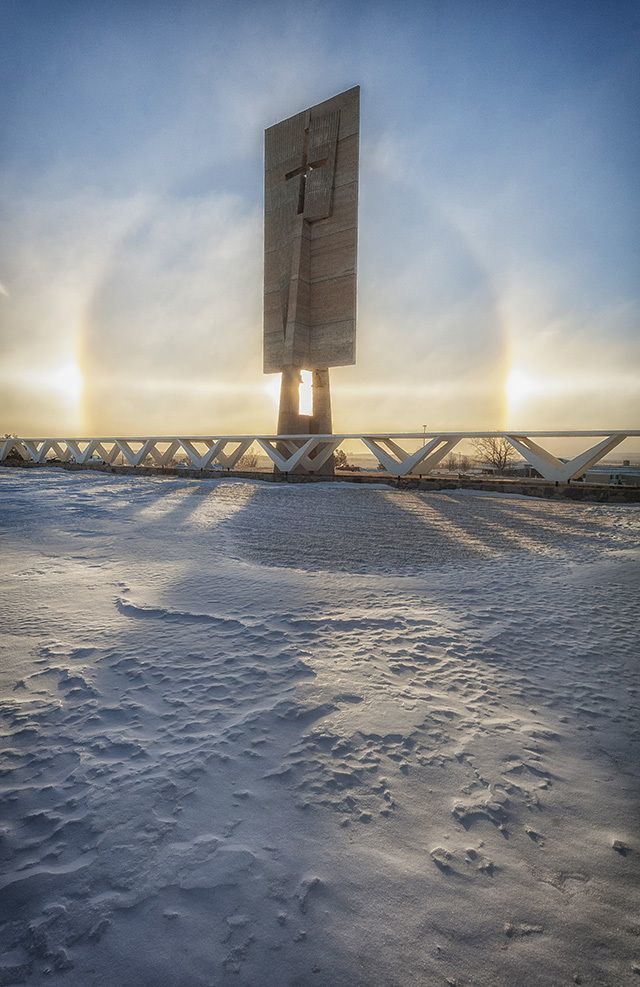
Bell Banner Photo by Jerry Anderson Photography
The bell banner is the landmark and symbol of the Benedictine Sisters of Annunciation Monastery. This hundred-foot structure is a symbol, landmark and belfry. The late architect, Marcel Breuer, wrote: "From afar, the bell tower makes a distinctive silhouette in the otherwise fairly empty landscape, and from nearby marks the approach to the chapel." The windswept cross, hollowed out, as it were, by the Spirit, is a sign of faith, and leads directly to the water (baptismal symbol at the chapel entrance) and to the monumental Eucharistic altar.
The bronze bells were cast in Holland and are named Hilary (in honor of Bishop Hilary Hacker, who was Bishop of Bismarck at the time), Joseph (for Monsignor Joseph Raith), and Mary (honoring the Blessed Virgin Mary, the community patron). The bells were consecrated on June 18, 1962.
Bell Banner of Annunciation Monastery
Since 1878 in Bismarck, North Dakota,
Benedictine Sisters have gathered in prayer
every morning and evening to give praise to
God and to pray for the people of this region
and the world.
The bell banner, an architectural masterpiece,
was designed by world-renowned architect
Marcel Breuer.
The three bells; Hilary, Joseph and Mary,
faithfully call the Benedictine Sisters to prayer
each day. The tolling of the bells reminds us of
God's presence in our world and invites all
who hear to echo God's message of infinite
love and peace.
The open cross at the top of the bell banner
was designed to represent the risen Christ and
let the North Dakota winds sail through. As if
God is openly smiling, a shadow of the cross is
cast on Our Lady of the Annunciation Chapel
during the winter solstice."
